X.Oct
6
03Birthday of TRIZ Master Mikhail Sharapov
10Birthday of TRIZ Master Sergey Kravtsov
13Birthday of TRIZ Master Mark Meerovich
152025 TRIZ Tournament for School Students and University Students
15TRIZ Day at St. Petersburg School No. 207
19Birthday of TRIZ Master Igor Vikentiev
XI.Nov
7
07Birthday of TRIZ Master Nikolay Kaloshin
12Birthday of TRIZ Master Mikhail Rubin
18Birthday of TRIZ Master Yury Stupniker
19Birthday of TRIZ Master Nina Linkova
24Birthday of TRIZ Master Lev Shulyak
26Birthday of TRIZ Master Lev Pevzner
26Birthday of TRIZ Master Alex Lyubomirsky
XII.Dec
6
02Birthday of TRIZ Master Vadim Kaner
09Birthday of TRIZ Master Nikolay Khomenko
15Birthday of TRIZ Master Larisa Shragina
17Birthday of TRIZ Master Igor Kholkin
21Birthday of TRIZ Master Marat Gafitulin
31Birthday of TRIZ Master Boris Zlotin
I.Jan
6
01Birthday of TRIZ Master Alexander Narbut
08Birthday of TRIZ Master Viktor Timokhov
21Birthday of TRIZ Master Yuri Fedosov
27Birthday of TRIZ Master Mikhail Shusterman
28Birthday of TRIZ Master Valery Mikhailov
28Webinar "Compinno-TRIZ with LLM for Efficient Inventive Problem Solving". Speaker TRIZ Master Kulakov A.
II.Feb
9
01Birthday of TRIZ Master Alla Zusman
02Birthday of TRIZ Master Aleksey Podkatilin
09Birthday of TRIZ Master Alexander Nikashin
18Roundtable. Krasnoyarsk (Lopatin, Kraev, Trantin, Kulakov)
19Meeting at a university in Krasnoyarsk (Trantin, Kulakov)
20Birthday of TRIZ Master Pesach Amnuel
21Birthday of TRIZ Master Volyuslav Mitrofanov
24Birthday of TRIZ Master Semyon Litvin
26Webinar: TRIZ Teaching Programs (Rubina)
III.Mar
9
03Birthday of TRIZ Master Vladimir Gerasimov
04Birthday of TRIZ Master Miloslava Zinovkina
20 Program of the Joint Webinar within the TRIZ Developers Summit (TDS) and the International TRIZ Official Association (MATRIZ Official)
21Program of the Joint Webinar within the TRIZ Developers Summit (TDS) and the International TRIZ Official Association (MATRIZ Official)
23Birthday of TRIZ Master Sergey Gubanov
25Roundtable. Irkutsk. (Labunsky, Trantin, Kulakov)
26Meeting at a university in Irkutsk (Trantin, Kulakov)
29Birthday of TRIZ Master Vadim Salnikov
30"TRIZ Technologies in the Educational Process" — 6th Interregional Scientific-Practical Conference with International Participation, Dedicated to the 100th Anniversary of the Birth of G.S. Altshuller
IV.Apr
10
06Birthday of TRIZ Master Alexander Syolyutsky
07Birthday of TRIZ Master Valery Tsurikov
09Birthday of TRIZ Master Igor Gorchakov
13Birthday of TRIZ Master Valentina Kryachko
15Meeting at a university in Bratsk (Trantin, Kulakov, Volokhov)
16Birthday of TRIZ Master Alexander Torgashev
16 Birthday of TRIZ Master Anatoly Gin
22Webinar TRIZ in fundamental physics (Misyuchenko)
27Birthday of TRIZ Master Viktor Ladoshkin
29Birthday of TRIZ Master Alexander Trigub
V.May
5
10Birthday of TRIZ Master Georgy Pigorov
25Birthday of TRIZ Master Alexander Gasanov
25Birthday of TRIZ Master Valery Beliltsev
26Birthday of TRIZ Master Vissarion Sibiryakov
27Meeting at a university in Yekaterinburg (Trantin, Kulakov)
VI.Jun
4
02Birthday of TRIZ Master Victor Fey
12Birthday of TRIZ Master Margarita Bdulenko
13Birthday of TRIZ Master Natalya Narbut
22Birthday of TRIZ Master Valery Sychev
VII.Jul
9
04 Birthday of TRIZ Master Nikolay Kolchev
07 Birthday of TRIZ Master Yuly Murashkovsky
15Webinar RTV in Compinno-TRIZ (Rubina, Sysoev)
18Birthday of TRIZ Master Yuri Gorin
20Birthday of TRIZ Master Isaac Buchman
24 Birthday of TRIZ Master Anatoly Limarenko
24Birthday of TRIZ Master Yury Salamatov
25 Birthday of TRIZ Master Vladimir Petrov
30Birthday of TRIZ Master Alexander Kislov
VIII.Aug
2
12Webinar: The Meaning of MG Graphics for TRIZ (Gaftulin)
20Birthday of TRIZ Master Esfir Zlotina
IX.Sep
5
02Birthday of TRIZ Master Zinovy Royzen
09Meeting at a university in St. Petersburg (Trantin, Kulakov, Rubin)
10Meeting at a university in Moscow (Trantin, Kulakov, Rubin)
11Birthday of TRIZ Master Kirill Sklobovsky
27Birthday of TRIZ Master Gennady Ivanov

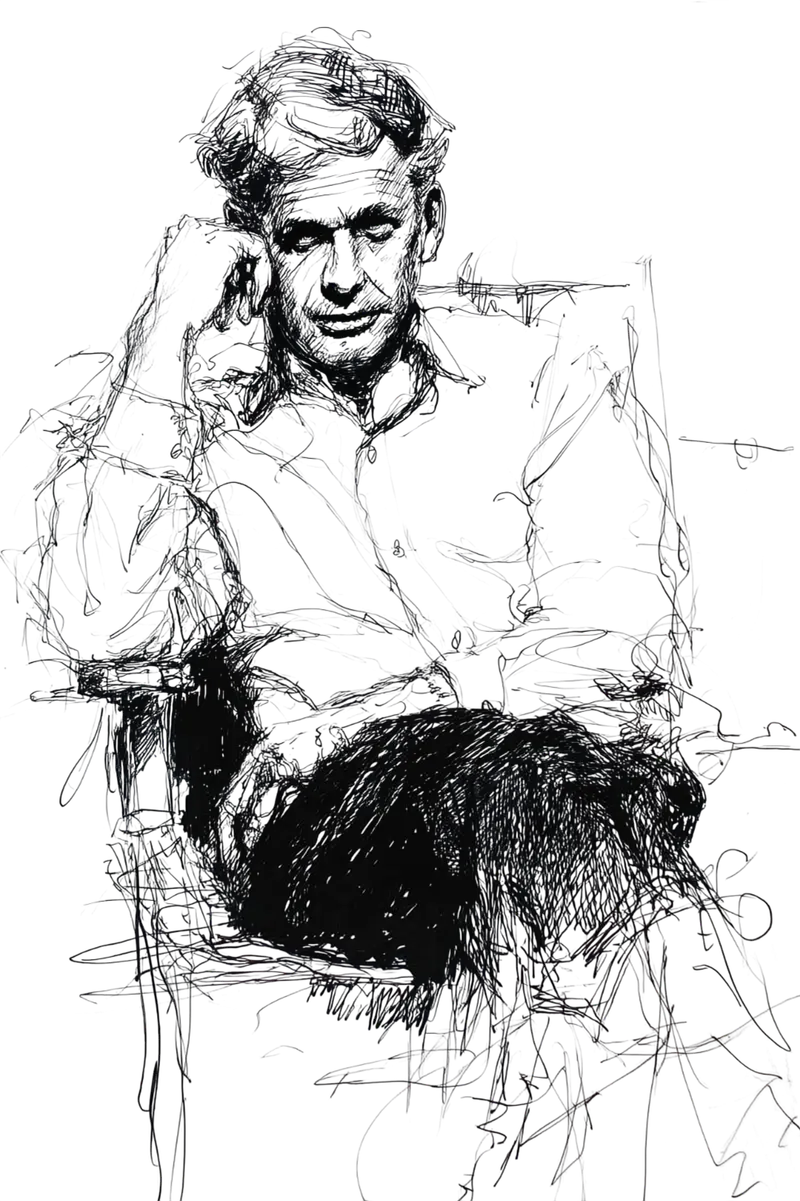
1926–1998

Events from Altshuller’s Life

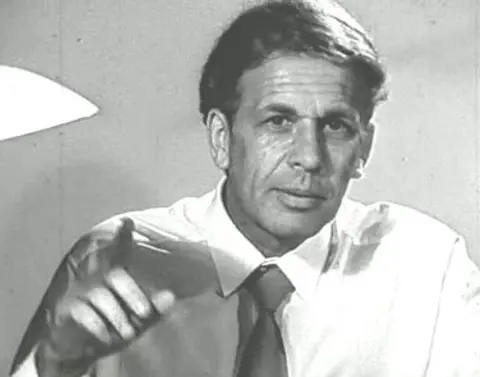
G. S. Altshuller

Founder of TRIZ, science fiction writer

G. S. Altshuller
1926
15.X
life

Birthday of the author of TRIZ, science fiction writer G.S. Altshuller

Genrikh Saulovich Altshuller was born on October 15, 1926, in Tashkent. His parents were journalists Saul Efimovich Altshuller and Revekka Yulievna Altshuller. According to Genrikh Saulovich’s own recollections, his parents met at the Azerbaijan Telegraph Agency, where a romance blossomed between them. However, since his father was already married, religious traditions stood in the way of a new marriage, forcing the young couple to flee to Tashkent.

1931
In 1931, the family returned to Baku
IV
life

In 1931, the family returned to Baku

1947
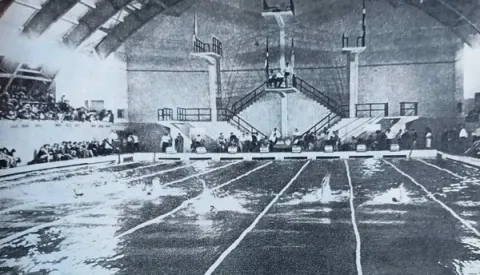
Ten Minutes Underwater on a Bet, 1947
VI
once

Ten Minutes Underwater on a Bet, 1947

One day in 1947, Altshuller and Shapiro devised a method for staying underwater for an extended period without a diving suit. To do this, they hyperventilated their lungs with oxygen. They wanted to surprise the world with their invention, and that's when they saw professional swimmers in a swimming pool. Shapiro went to negotiate and bet some beer that his friend could stay underwater for more than ten minutes. In the stifling Baku heat, the others saw an easy way to a cold drink and took the bet. Altshuller sank to the bottom of the pool and waited out the required time. There were two main challenges. The first was not to stay in the pool for too long, lest they suspect a trick. The second, which came after the feat, was to convincingly feign deep, heavy breathing. The bet was won. Altshuller and Shapiro were delighted to have amazed at least a small part of the world. (As recounted by M.S. Rubin)

1948
Icarus, Daedalus and the IFR, 1948–1985
IX
once

Icarus, Daedalus and the IFR, 1948–1985

One day around 1948, during discussions with D.D Kabanov (from the patent department of the Caspian Military Flotilla), G.S. Altshuller arrived at the idea that a key element of invention was a contradiction within the pursuit of an ideal. In the following years, Altshuller continued to ponder these tools—what to call them and how to formulate them. While developing ARIZ-59, he needed a vivid metaphor for an ideal solution. That's when his own written fiction story, "Icarus and Daedalus", proved pivotal. The longing for the sun—an unreachable ideal—was echoed in the Russian abbreviation of IFR (Idealnyy Konechnyy Rezultat, or "IKR"), which called to mind Icarus while standing for "Ideal Final Result". The IFR later became a cornerstone of TRIZ. Furthermore, Icarus and Daedalus re-emerged in Altshuller's work in 1985 as the names for his training programmes, "Icarus" and "Daedalus" (from the collection "TRIZ in Development," p. 122). It's a brilliant tale of Altshuller's creative journey from 1958 to 1985. (As recounted by M.S. Rubin)

Read the story
1949
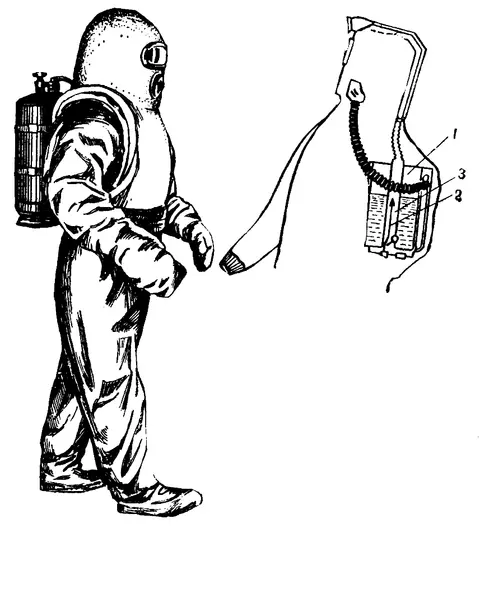
Mine Rescuer's Suit, 1949
II
once

Mine Rescuer's Suit, 1949

One day in 1949, G.S. Altshuller and R.B. Shapiro decided to enter a competition. It had been announced by the USSR Ministry of the Coal Industry, challenging inventors to create a cooling suit for mine rescuers. Everyone considered the problem unsolvable. The physics were against them: the total weight of the necessary gear—the tools, respiratory apparatus, and cooling system—would logically come to over 34 kg. Yet the competition rules stipulated a maximum of 28 kg. An unsolvable problem was exactly what was needed to test their methodology for solving inventive problems, but the risk was great. What held them back was the fear that nothing would come of it. That's when, Altshuller recounted, he took the plunge. Step by step, he applied the methodology, which suggested one thing: the breathing apparatus and the cooling system must be combined. This could be achieved using liquid oxygen. Two functions from a single substance. Thus, for the first time, an "unsolvable" problem was solved using ARIZ. (From an interview with Igor Vertkin) read more

Read the story
1950
IX
once

Refusal of Labor at Rechlag, 1950

One day in 1950, after arriving at the Rechlag camp in Vorkuta following a trial, Altshuller firmly decided he would not waste his life on daily camp labor. So, on his very first "working" day in the camp, he simply did not show up for work. To Altshuller, this seemed like an important, principled decision for the next 25 years. From the camp administration’s perspective, such a decision appeared quite harmless and even calm. The "working" day ended uneventfully; Altshuller spent it as he considered most useful for himself. Then the brigade leader approached him. He calmly explained that Altshuller’s refusal to perform hard labor concerned not just him personally—the quota was distributed across the entire brigade. The whole brigade had been forced to work extra because of Altshuller’s liberty. For this first time, Altshuller was forgiven due to ignorance, but he was warned that such leniency would not be repeated. They even gave him a hint: go see the camp doctor. Altshuller did just that. Even many years later, Altshuller could not understand how he managed to persuade the camp doctor: charm, firmness, intellect, humor, or perhaps genuine illnesses… The fact remained that Altshuller obtained an exemption from hard camp labor and was able to engage in self-education, inventing, and solving engineering problems while in the camp. (From the memoirs of M.S. Rubin)

1951
VII
once

The Mattress Full of Books, 1951

One day in 1951, Altshuller found himself having to relocate to another barracks in the Rechlag camp at Vorkuta. Such rotation was a regular occurrence in the camp. Practically the only possession an inmate had was his mattress. Altshuller regularly received books from his mother, which he had requested: scientific literature, science fiction, history books, and so on. The only place for storage was the mattress. Altshuller gradually pulled out the stuffing and filled it with books. Slowly, the mattress became too heavy for one man to lift. The inmates in the camp laughed at Altshuller, but not once in four years was there an instance when someone did not help him carry the weighty mattress to a new place. In 1954, Altshuller was released. That's when the need arose for help to carry all these books out of the camp. Altshuller recalled with sadness that not a single camp worker could be found who would help him carry the books out. (As recounted by M.S. Rubin)

1952
VIII
once

The Unsolvable Problem

Around 1952 in the Vorkuta camp, Altshuller was again summoned to an urgent, unscheduled meeting. This had happened repeatedly whenever the camp administration faced insoluble problems. This time, an absurd situation had arisen: a small locomotive pushed coal carts into the mine along rails. It could deliver them to the required spot, but then a problem emerged because the locomotive could not exit the mine. This disrupted the entire coal-loading process. An inspection commission was due to arrive, and there was no time to widen the mine shaft. It was necessary to devise at least a temporary solution that could be demonstrated to the high-level commission. All the officials looked at Altshuller with hope. And then he proposed the only possible solution in this case: there was a gap of about half a meter between the carts and the mine walls. Additional rails were laid in this space, along which an electric tractor was set running on metal arches. In this way, the carts were transported into the mine. It was difficult to overcome the inertia of thinking: the electric tractor and the carts could travel on different rails. Thus, another "unsolvable" problem was resolved.

1953
XI
once

A New Fascinating Story Every Evening in Rechlag

One day around 1953, the prisoners returned to the barracks where G.S. Altshuller was staying after a hard day's work. The exhausted men longed to distract themselves and take a rest. It was then that the interesting and gripping stories told by Genrikh Altshuller couldn't have come at a better time. But how could he tell something new every single evening? In his youth, Altshuller had read extensively, covering science fiction, adventure tales and classic literature. The novels of Alexandre Dumas, Jules Verne, H.G. Wells and others were of great help to him. Yet problems cropped up very soon. First, he had to tell the stories with enthusiasm and authenticity, for the camp audience would not tolerate any falsehoods. Second, he could never repeat himself. It was at this point that Altshuller realized he had retold every plot he could possibly remember. He had to come up with new plots and new gripping stories on the spot. And so, in the harsh conditions of the camp, the future science fiction writer G. Altov and G.S. Altshuller, the originator of fairy tale creation methodologies, gradually took shape.

1956
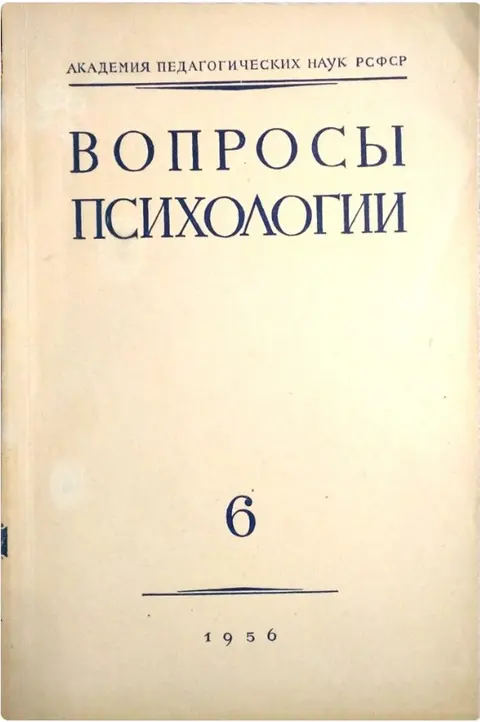
The first publication on TRIZ by G.S. Altshuller and R.B. Shapiro, December 1956.
XII
TRIZ

The first publication on TRIZ by G.S. Altshuller and R.B. Shapiro, December 1956.

The article "On the Psychology of Inventive Creativity" by G.S. Altshuller and R.B. Shapiro is devoted to the study of the psychological aspects of technical creativity, in particular, the inventive process. The authors criticize existing approaches to the study of technical creativity, noting their insufficient scientific validity and lack of a systematic approach. They propose their own methodology based on the three stages of the creative process: analytical, operational, and synthetic. The article examines each stage in detail, including task selection, identification of contradictions, search for solutions, and evaluation of the invention. The authors also emphasize the importance of the systematic study of inventors' experience and the application of the experimental method for the further development of the psychology of inventive creativity.

1958
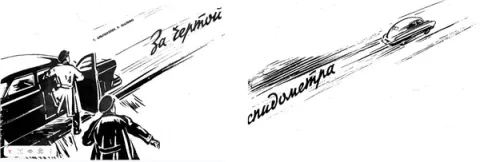
Science Fiction Detective Story "Beyond the Speedometer", 1958
VI
science fiction

Science Fiction Detective Story "Beyond the Speedometer", 1958

1958. G.S. Altshuller, R.B. Shapiro. Journal "Tekhnika-Molodyozhi", 1958, No. 6. Story "Beyond the Speedometer's Limit".

Debut of Science Fiction Writer G. Altov: The Story "Icarus and Daedalus"
IX
science fiction

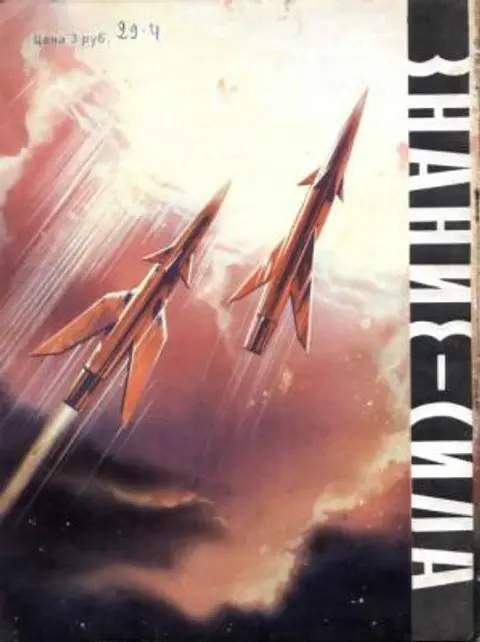
Debut of Science Fiction Writer G. Altov: The Story "Icarus and Daedalus"

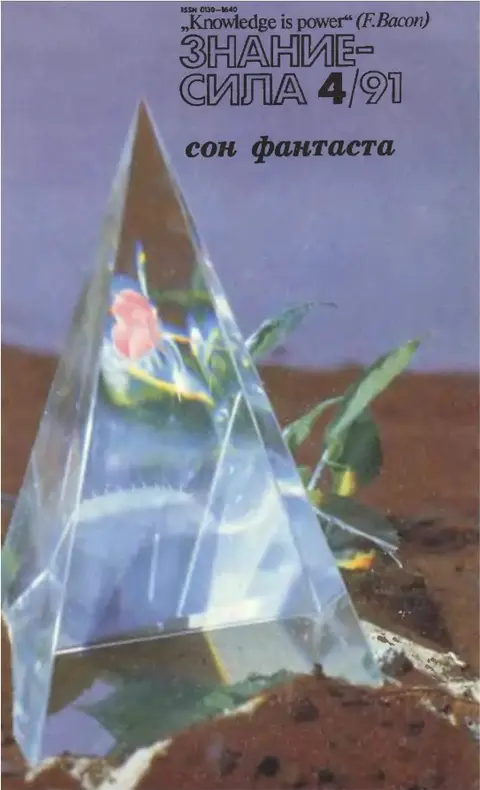
1958. Debut of science fiction writer G. Altov. Magazine "Znanie-Sila", 1958, Issue 9. Science fiction story "Icarus and Daedalus".It was long ago. Time has erased from the memory of generations the true names of those who flew toward the Sun. People began to call them by the names of their ships—Icarus and Daedalus. Some say the ships had other names, and the names Icarus and Daedalus were taken from an ancient myth. That is hardly the case. For it was not Daedalus, but the one now called Icarus who first said to people: "We will fly through the Sun!"It was long ago. Humans still timidly ventured beyond Earth. Yet they had already known the intoxicating beauty of the Starry World, and the wild, irrepressible spirit of discovery drove them toward the stars. And if one ship perished, two more set off into the Starry World. They returned after many years—scorched by the heat of distant suns, pierced by the cold of endless space. And they set off again... read more

1959
1959. G.S. Altshuller, R.B. Shapiro. Expulsion of the Six-Winged Seraph
X
TRIZ

1959. G.S. Altshuller, R.B. Shapiro. Expulsion of the Six-Winged Seraph

1959. G.S. Altshuller, R.B. Shapiro. “Expulsion of the Six-Winged Seraph"Expulsion of the Six-Winged Seraph".

Journal "Inventor and Rationalizer", 1959, No.10

The article "Expulsion of the Six-Winged Seraph" by G.S. Altshuller and R.B. Shapiro is devoted to the criticism of traditional views on the nature of inventive creativity and the development of a methodology that allows a systematic approach to solving inventive problems. The authors state that inventions are not the result of random insights, but can be created on the basis of certain laws and methods. The article describes the three-stage process of inventive creativity: analytical, operational and synthetic stages, each of which includes specific steps and logical operations. The authors also provide examples of the successful application of their methodology, emphasizing its effectiveness and practical significance.

1961
1961. The first book on TRIZ. G.S. Altshuller. "How to Learn to Invent"
VIII
TRIZ

1961. The first book on TRIZ. G.S. Altshuller. "How to Learn to Invent"

1961. G.S. Altshuller. "How to Learn to lnvent ", Tambov Book Publishing House, 1961.

This is the first full-fledged (128 pages) book on the methodology for solving inventive problems. The print run of the book was 50,000 copies. The book summarized the experience of researching 4,000 of the strongest solutions from the patent fund, the first training seminars on methods for solving inventive problems, and the first results of the use of TRIZ. It includes: a review of the shortcomings of existing approaches to creativity, a brief history of the development of TRIZ, a description of the algorithm for solving inventive problems with detailed problem analyses, and some techniques for resolving technical contradictions. The book discusses the topic of the laws of development of technical systems using numerous examples from the patent fund and the history of the development of technical systems.

1963
1964
1964. G.S. Altshuller. "Fundamentals of Invention"
V
TRIZ

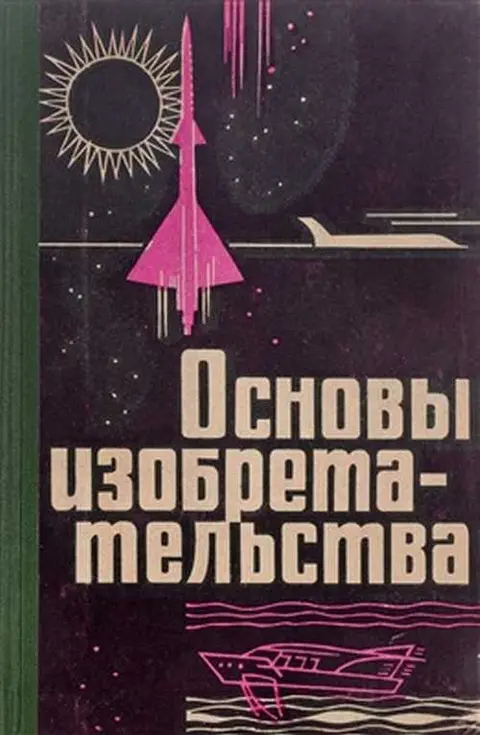
1964. G.S. Altshuller. "Fundamentals of Invention"

1964. G.S. Altshuller. "Fundamentals of Invention". Voronezh Central Black Earth Publishing House, 1964.

Written in a popular science style, the book contains a detailed analysis of the history of the development of technical systems, an algorithm for solving inventive problems, 69 techniques for resolving technical contradictions with a table of technique selection, the definition of an ideal machine… A large number of examples are used in the description. Most of the book is devoted to describing the analysis and solution of practical problems using the algorithm for solving inventive problems, as well as describing the laws of development of technical systems with examples from the history of technology.

1969
1969. G.S. Altshuller. "Algorithm of Invention"
III
TRIZ

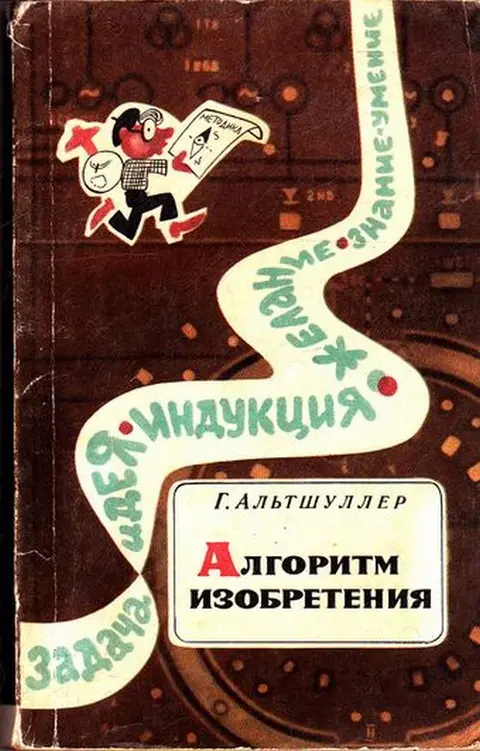
1969. G.S. Altshuller. "Algorithm of Invention"

1969. G.S. Altshuller. "Algorithm of Invention". Moscow, Moscow Worker,

1st ed., 1969;

2nd ed., 1973;

This book describes in detail the basic theoretical provisions of TRIZ using a large number of examples and educational problem analyses. The book includes the results of research on the laws of development of technical systems using the modern patent fund. Several chapters are devoted to describing the solution of problems using ARIZ-61 and analyses of problems based on ARIZ-71. This book first presented a revised list of 40 Techniques for Resolving Technical Contradictions with a table of techniques, which is still used by many TRIZ specialists today.

1971
STC Operator, 1971
III
once

STC Operator, 1971

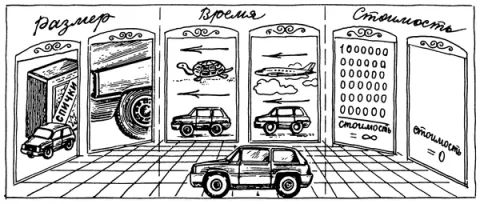
One day in 1971, G.S. Altshuller was once again contemplating how to develop the imagination for solving inventive problems. ARIZ-68 already contained recommendations related to the imaginary manipulation of time: to "compress" time, "stretch" time, do something in advance, and so on. Such recommendations were useful but clearly incomplete. Suggesting changes to other parameters of an object merely resulted in a poorly structured and hard-to-remember list of advice. That's when Altshuller recalled a very popular short story from those years by Arkady Gaidar, which was called "R.V.S."—short for Revolutionary Military Council in Russian (ReadListen). Plays were staged and films were made based on this story (Watch). In this acronym, Altshuller saw an easily memorable piece of advice, which he named the "STC Operator": changing Size, Time, and Cost. In the works of Altshuller, the founder of TRIZ, one could always find the science fiction writer G. Altov. And conversely, in the science fiction of G. Altov, one could always find the inventor G.S. Altshuller. (As recounted by M.S. Rubin)

Read the story
1973
A Book for "Light Reading", 1973
VI
once

A Book for "Light Reading", 1973

One day in 1973, while preparing for a mountaineering camp, I was looking for a book for light, entertaining reading in the library. That's when my friend Yura Orlov recommended a book I hadn't seen before. The title and cover made it clear it was a frivolous, fantastical work: "Algorithm of Invention" of 1969, by an author unknown to me at the time—G.S. Altshuller. As the publisher was "Moscow Worker", I was convinced it was the head of some major Moscow institute popularising the scientific activities of his organisation. At that time, I was very interested in cybernetics, and I was struck by one of the quotes Altshuller included (P. Kapitsa. "The Future of Science". "Science and Life", No. 3, 1962, p. 23): "If there is intuition, then there are also patterns. The task of science is to reveal these patterns." It could be said that all of Altshuller's creative work in the field of TRIZ was dedicated to implementing this short thesis: turning intuition into a scientifically grounded search. (As recounted by M.S. Rubin)

Read the story
1974
Film "Algorithm of Invention"
I
filmography

Film "Algorithm of Invention"

In 1974, the film ”Algorithm of invention“ was released by the studio "Central Studio of Popular Science Films" (CSPSF). The screenwriter and director was G.S. Altshuller. The film reveals the fundamental principles and methods of TRIZ. It vividly and engagingly features segments of classes at the Azerbaijan Public Institute of Inventive Creativity (АзОИИТ) in Baku. Viewers can observe students solving inventive problems, witness the birth of new, original solutions, and see how creative thought operates.

Meeting Vladimir Vysotsky, 1974
V
once

Meeting Vladimir Vysotsky, 1974

One day in 1974, the author of the film "Algorithm of Invention", M. Chekhovskaya, invited Altshuller to Moscow to record the voice-over narration, as they couldn't find anyone else whose voice suited the atmosphere of the film. In Moscow, Altshuller finished his work on the film. That's when M. Chekhovskaya, together with her husband, suggested to Altshuller that he meet Vladimir Vysotsky. They met somewhere on the street and went to M. Chekhovskaya's home. Altshuller was struck by how Vysotsky sang his songs for him with complete dedication—as if performing before a vast concert hall. Altshuller himself approached his work in exactly the same way—with full commitment and at the very limit of his capabilities.

VIII
once

Live Thought Reference, 1974

One day in 1974 in the evening, I per usual went to G.S. Altshuller's home to consult about my work on research card files in TRIZ. I had interviewed many TRIZ specialists in Baku and proposed a certain classification of card files and stages in their evolution. That's when Altshuller added some details to my proposals. Being a principled researcher, I immediately rejected his suggestion—as there had been no such publications or facts in my interviews. Altshuller, sitting at his desk, proposed the following chain of reasoning. He said that right then, he could write down the suggested ideas on paper and type them up. Obviously, that was possible. Next, Altshuller said, he could publish this text. He was a well-known writer; his works were published in books, magazines, and newspapers. Obviously, he could publish another one of his ideas. And then, Altshuller said, you could cite it in your work—but why wait so long? That evening, this rather simple thought struck me. The living thought of a talented person could prove more powerful than a formal publication. (As recounted by M.S. Rubin)

M.S. Rubin. Personal Card Files—The Foundation of Creativity. 1975–1995, Baku–Petrozavodsk

IX
once

Analogies and the IFR, 1974

One day in September 1974, I needed to choose a topic for my diploma thesis. For half a year, I had been conducting research based on functional analogies from the works of Tamerlan Kengerli. (T.A. Kengerli. The Transfer of Technical Solutions in Inventive Creativity). With G.S. Altshuller, I planned to approve a topic at the intersection of functional analogies and solving contradictions. The analogy suggested a general solution, while the contradiction arose between the analogue and the system under consideration. I explained all this to Genrikh Saulovich. That's when it turned out he was against this topic. This was somewhat unexpected, as the topic of analogy was discussed in many of Altshuller's own works, but in our discussion, he firmly stood his ground: the best and most universal analogy is the Ideal Final Result (IFR). We, all of Altshuller's students, tried to emulate him, and in that same spirit, I began to insist that analogy had its own particular advantages compared to the IFR. To my surprise, Altshuller didn't argue. He simply said: "Work on analogies, but without me. If it's with me, then it's other topics." Over the next twenty years, Altshuller and I conducted various research projects on TRIZ, but the topic of analogies was not among them. (As recounted by M.S. Rubin)

Read the story
Come not only on Wednesdays... 1974
XI
once

Come not only on Wednesdays... 1974

One day at the end of 1974 during a class at the Azerbaijan Public Institute of Inventive Creativity, Gennady Filkovsky approached me and said that Altshuller had invited me to his home the following Wednesday. Another meeting of the members of the Public Laboratory of Inventive Methodology (OLMI) was planned—with Y.V. Gorin, Khotimlyansky, G.L. Filkovsky, and others. Our regular Wednesday evening gatherings at Altshuller's home on Neftpererabotchikov Street were not only intensely interesting but were also sustained by delicious sandwiches provided by V.N. Zhuravleva. In Altshuller's small study, we discussed visions for future standards on solving inventive problems and other captivating topics, which I listened to with great attention. That's when one day Altshuller suggested we shouldn't just meet on Wednesdays, but whenever was convenient for each person. Thus, the meetings at Altshuller's transitioned to a one-on-one format. At first, Altshuller would talk about himself, his current work, and letters from his students. But one day, he stopped keeping up the conversation. I sat on the little sofa, while Altshuller sat opposite me at his desk, reading a book. A tense silence filled the room. There was no topic for discussion. The only valid reason for the next meeting with Altshuller could be the research work accomplished over the week. And so, for many years, a certain rhythm was established: a week's work, a brief report on what was done, a discussion, and a new assignment. (As recounted by M.S. Rubin)

Read the story
1976
I
once

There's No Such Thing as a Flow Meter "In General"... 1976

One day in 1976, Altshuller was looking for a research topic for me. Since at that time, at the university's electronics department, I was working on electromagnetic flow meters, he suggested I research the patterns of development in electromagnetic flow meters. I began gathering materials—inventions, monographs. The material accumulated month by month. That's when, at one of our regular meetings, Altshuller told me that electromagnetic flow meters were too narrow a focus, insufficient to see more global patterns, and he proposed researching the evolution of flow meters in general. When I mentioned this idea at the electronics department at the institute, I was met with ridicule. There is no such thing as a flow meter "in general". Vortex flow meters cannot be compared with electromagnetic ones, and electromagnetic ones are completely different from ultrasonic ones. The research was doomed to fail from the very start. However, in practice, Altshuller's position proved productive. It was possible to identify common contradictions and directions of evolution for flow meters of any type. In 1978, an article on this topic, "The Development of Flow Meters", was prepared. In research work, Altshuller always adhered to the strategy of pushing upwards to the maximum—towards the supersystem. (As recounted by M.S. Rubin)

Read the story
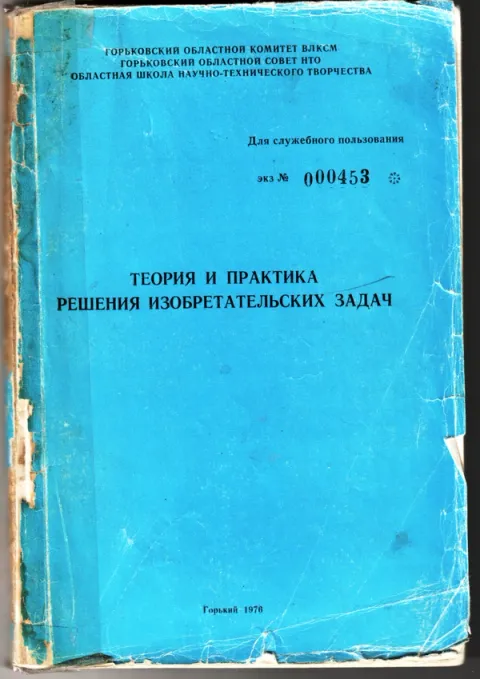
1976. G.S. Altshuller. "Theory and Practice of Inventive Problem Solving"
III
TRIZ

1976. G.S. Altshuller. "Theory and Practice of Inventive Problem Solving"

1976. This is an extremely rare book published in a very limited print run. The book examines in detail the methods of psychological activation of creative thinking that preceded TRIZ; it provides an analysis of educational inventive problems based on ARIZ-71-B; it explores methods for overcoming psychological inertia such as the RVS operator and the MMCH method; it describes in detail ve-pol analysis; it also outlines the application of physical effects and phenomena in solving inventive problems.

1979
1979. G.S. Altshuller. "Creativity as an Exact Science"
IV
TRIZ

1979. G.S. Altshuller. "Creativity as an Exact Science"

1979. G.S. Altshuller. "Creativity as an Exact Science". Moscow, Soviet Radio, 1979The bulk of the book consists of new developments. The book includes more than 70 descriptions of inventive problems, the text of ARIZ-77 and analyses of problems using the new version of ARIZ. For the first time, the system of laws of development of technical systems, ordered in accordance with the key stages of development: Statics, Kinematics, Dynamics, is presented. For the first time in wide circulation, one of the first versions of the System of Standards for Solving Inventive Problems, the principles of value analysis and a table of the use of certain physical effects are demonstrated. The book also provides 40 techniques for solving inventive problems and a short article on their development. Several parts of the book are devoted to the S-shaped curve of system development and approaches to solving scientific problems.

IX
once

KGB at TRIZ seminars, 1979

One day around 1979 in Baku, while discussing his upcoming lecture on science fiction, Altshuller shared his perspective. He said that at all his lectures, he would identify the KGB agent in attendance and do everything to put him in an awkward position. He would ask him questions, propose he solve this or that problem, catch him out on faulty reasoning. It was clear Altshuller took pleasure in this process. That's when I asked: "But what if you were mistaken, and there was no KGB representative at all?" Altshuller firmly rejected such a possibility. Subsequent experience in our communication showed that, until the end of his life, he stayed prepared for a security services officer to visit him with some questions. (As recounted by M.S. Rubin)Read more

Read the story
1980
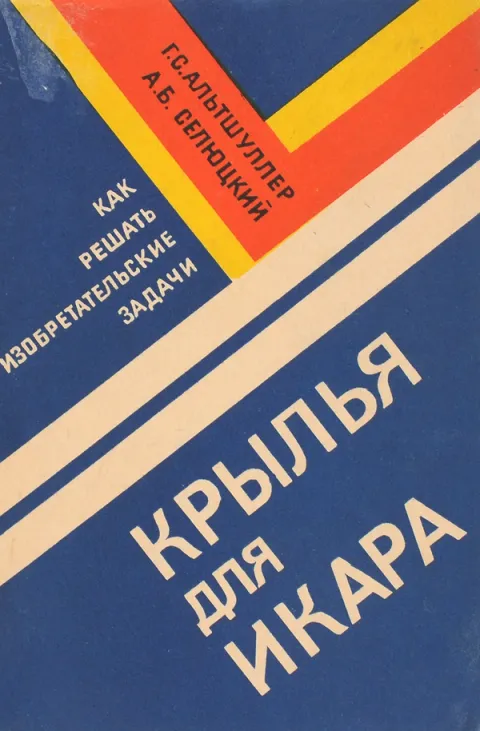
1980. G.S. Altshuller, A.B. Selyutsky. Wings for Icarus. Petrozavodsk, "Karelia", 1980.
V
TRIZ

1980. G.S. Altshuller, A.B. Selyutsky. Wings for Icarus. Petrozavodsk, "Karelia", 1980.

G.S. Altshuller, A.B. Selyutsky. Wings for Icarus. Petrozavodsk: Karelia Publishers, 1980.

This book continues and develops some ideas from the book Creativity as an Exact Science. It examines some sections of TRIZ in greater detail and provides an analysis of 50 training problems. The book presents the fundamentals of TRIZ in a more popularized form than Creativity as an Exact Science. It outlines the five basic rules of Vepol analysis, which facilitate the mastery of later versions of the System of Standards, up to the system comprising 76 standard inventive solutions.

The Most Important Book, Early 1980s
VII
once

The Most Important Book, Early 1980s

One day in the early 1980s, during one of our working meetings, I asked Altshuller for advice on which books to read first. I often sought such guidance from him. Usually, it was science fiction, literature, or history books. That's when Genrikh Saulovich named as the first and most important book the Bible, the New Testament, and above all, the Gospel of Matthew. In the USSR of the early 1980s, this was not merely unusual—it was on the very edge of what was permissible. As it later turned out, Altshuller's home contained icons, a Bible, and the New Testament. For the first time in my life, I received a New Testament from Altshuller's hands. (As recounted by M.S. Rubin)

From Earth Technology to the Synthetic Technological World, 1980
VIII
once

From Earth Technology to the Synthetic Technological World, 1980

One day in 1980, I came to Altshuller's home, buoyed by the near completion of the article "On the Influence of Earth Conditions on the Development of Technology". The very idea for the research belonged to Altshuller, and I was sure its conclusions would be incorporated into one of the versions of ARIZ he was preparing. That's when it emerged that Altshuller considered the topic too narrow. It turned out that earth conditions and all technology were too small a scale. The new level proposed by Altshuller was forecasting the development of civilisation, taking into account the patterns of its interaction with nature. It would take a further seven years for an article summarising this research to appear: "What Will Happen After the Final Victory. Eight Thoughts on Nature and Technology".

Read the story
VIII
once

From Mountaineering Equipment to the Sports Movement, Early 1980s

One day in the early 1980s, Altshuller proposed conducting another research project. As I was actively involved in mountaineering, the idea arose to analyse the development of mountaineering equipment. The research was very interesting. Mountaineering gear requires maximum resource utilisation, weight reduction with maximum functionality, and the use of geometric effects is clearly dominant. When the work "Analysis of the Development of Mountaineering Equipment" was almost ready, Altshuller said the topic was rather narrow. Why not consider the patterns of equipment development in sport as a whole, not just in mountaineering. The topic seemed hopeless—had it not been for the experience of the flow meter research, which also seemed difficult to do. I began searching for a model for sports equipment that would cover any sporting discipline. It necessarily included people, the sporting arena, the sports equipment itself, etc. The work continued for about a year. Enough material was gathered for an entire book, and the table of contents was already prepared. That's when, at our next meeting, Altshuller calmly said: "The topic of sports equipment is rather narrow. Now, analysing the sports movement as a whole—that would be interesting." All the patents, books, articles, and drafts that had been found had to be shelved. The topic of the sports movement now had a social, rather than a technical, character. Thus, under Altshuller's guidance, the article "Sport—The Trap of the 20th Century" came to be. (As recounted by M.S. Rubin)

Read the story
1982
XII
once

The Author and His Character, 1982

One day around 1982, Altshuller was lamenting all over again the low level of imagination in the works of many science fiction writers published in the USSR. By this time, together with Pavel Amnuel, he had prepared and published the "Fantasy-2" Scale, intended to help objectively assess the level of imaginative ideas in various authors. That's when Altshuller expressed a curious idea, which could be termed G. Altov's Law: "A character in a story cannot surpass its author in intelligence and inventiveness." Several years later, Altshuller reiterated this same thought in responses to a questionnaire for science fiction writers.

Read the story
1983
The Origin of Agent 000, 1983
I
once

The Origin of Agent 000, 1983

One day in 1983 in Baku, as usual, in the evening I visited G.S. Altshuller at his home. He shared with great enthusiasm a new and elegant idea that had come to him in a dream. In 1983, under the direction of Genrikh Saulovich, a series of articles on TRIZ was being published. They were all written under different names but edited by Altshuller. The immediate task to solve was devising a striking title for an article by Y.P. Salamatov on the application of ozone. Numerous options had been considered, but none pleased Altshuller. Inspiration simply wouldn't come. In the evenings, Altshuller loved to unwind by watching detective films, especially those about Agent 007, to take his mind off current tasks. That's when Altshuller dreamt of a new agent with unlimited capabilities greater than those of Her Majesty's Secret Service agents. While those agents always had two zeros before their number, signifying a licence to kill, the super-agent with three zeros could commit mass murder. That was Ozone, whose chemical formula is 000 (O3). Visually, 000 and 007 were very similar. And in the morning, Genrikh Saulovich finally noted down the article's title: "Agent 000". (As recounted by M.S. Rubin) "Agent 000" Article

Read the story
1984
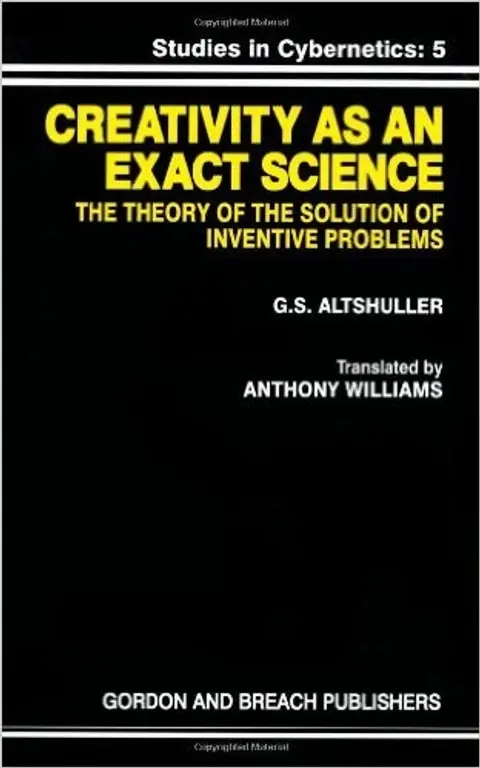
1984 год. G.S. Altshuller. "Creativity as an exact science".
II
TRIZ

1984 год. G.S. Altshuller. "Creativity as an exact science".

1984 год. G.S. Altshuller. "Creativity as an exact science". Gordon and Breach Publishers, 1984

The Theory of the solution of inventive problems

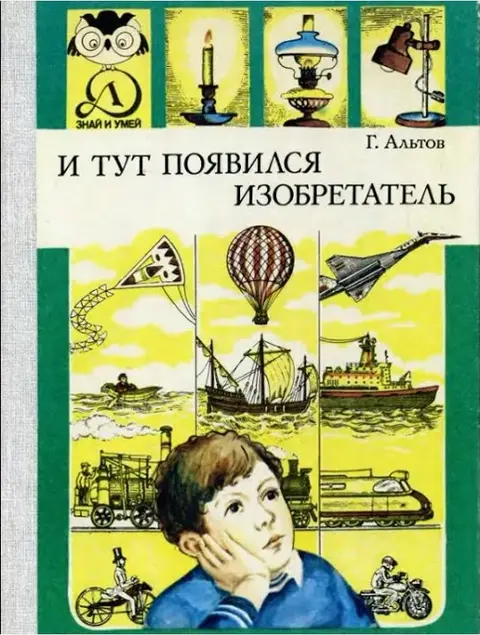
1984. G. Altov. "And Then the Inventor Appeared"
IX
TRIZ

1984. G. Altov. "And Then the Inventor Appeared"

1984. G. Altov. "And Then the Inventor Appeared". Moscow, Children's Literature, 1st ed., 1984;

2nd ed., 1987;

3rd revised and supplemented ed., 1989

This book was written in a popular style based on publications in "Pionerskaya Pravda" and is intended for schoolchildren. The book includes 78 inventive problems, solutions to most of which are considered in its pages. The book is devoted not only to solving technical problems, but also contains advice for future inventors.

Seminar in Dnipropetrovsk, 1984
XI
once

Seminar in Dnipropetrovsk, 1984

One day around 1984, Altshuller was conducting a two-week TRIZ seminar in Dnipropetrovsk. There were about a hundred participants, but in addition to them, many established TRIZ specialists also came as instructors and trainees: V.M. Gerasimov, S.S. Litvin, V.M. Petrov, I.M. Vertkin, V.R. Fey, S. Kreinina, and others. We had to work no less than twelve hours a day: the seminar ran during the day, followed by checking participants' homework, preparing for the next working day, and doing our own assignments. I had funded my trip to this important seminar myself, and to my surprise, my money ran out sooner than expected. I had to be modest with my food: half a glass of sour cream for breakfast. That's when something unexpected happened. After the seminar, Altshuller came over to me and asked why my breakfast was so meagre. He lent me a small sum, which I so desperately needed and later repaid to him in Baku. What surprised me was that there were so many of my colleagues around, yet only Altshuller—who was extremely overloaded with running the seminar—had noticed my problem. (As recounted by M.S. Rubin)

Ballet and the "Lost Shoe", 1984
XI
once

Ballet and the "Lost Shoe", 1984

One day around 1984, G.S. Altshuller and I were attending a TRIZ seminar in Dnipropetrovsk. After another day of sessions, we went with the other instructors to see a performance by the local ballet. During the show, the prima ballerina's pointe shoe flew off and landed in the middle of the stage. From then on, the entire audience watched only the fate of that shoe—how the dancers avoided it, how one of them "inconspicuously" picked it up. I felt sorry for the ballerina, and on the tram journey back, I said to Altshuller that one shouldn't judge a person if one couldn't do better oneself. That's when Altshuller said that the only standard a real professional can accept is excellence. Any professional task must be performed with the greatest dedication and at the highest level. This is how Altshuller approached his own work and that of his students. (As recounted by M.S. Rubin)

1985
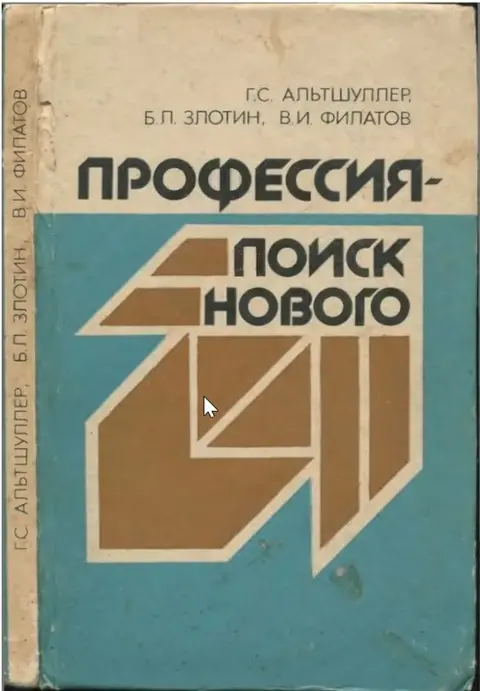
1985. G.S. Altshuller, B.L. Zlotin, V.I. Filatov. "Profession - Search for the New"
VI
TRIZ

1985. G.S. Altshuller, B.L. Zlotin, V.I. Filatov. "Profession - Search for the New"

1985. G.S. Altshuller, B.L. Zlotin, V.I. Filatov. "Profession - Search for the New". Kishinev, Kartya Moldoveniaske, 1985

This is the first book devoted to describing the joint use of TRIZ and FSA (Functional Value Analysis). It sets forth the basic provisions of FSA and TRIZ and examines the advantages of using TRIZ in the course of FSA through practical examples.

1986
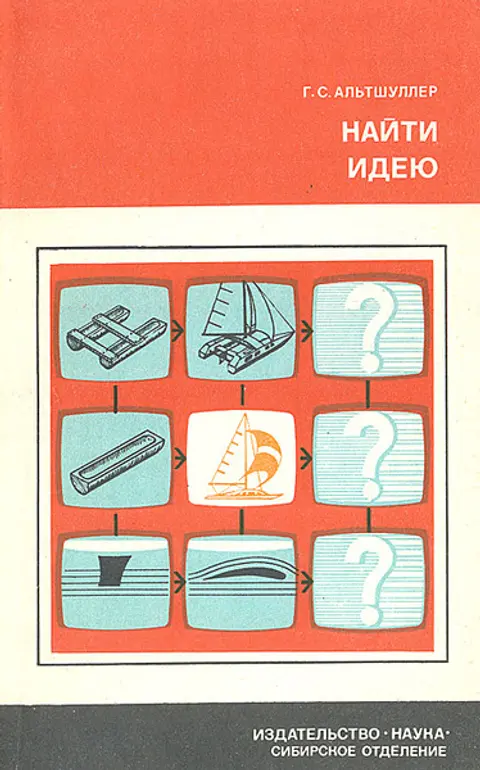
1986. G.S. Altshuller. "Find an Idea"
V
TRIZ

1986. G.S. Altshuller. "Find an Idea"

1986. G.S. Altshuller. "Find an Idea". Novosibirsk, Nauka, 1st ed., 1986;

2nd ed., 19913rd revised and supplemented ed., Petrozavodsk, Scandinavia, 2004

The book includes novellas on value analysis, a modern view on the Laws of Development of Technical Systems and a large number of examples. The text of the final author's version of the Algorithm for Solving Inventive Problems—ARIZ-85-V with examples of problem analysis was published for the first time in mass print. The second edition of this book, published in 1991 with a print run of 16,000 copies, added a section devoted to the Life Strategy of a Creative Personality.

1987
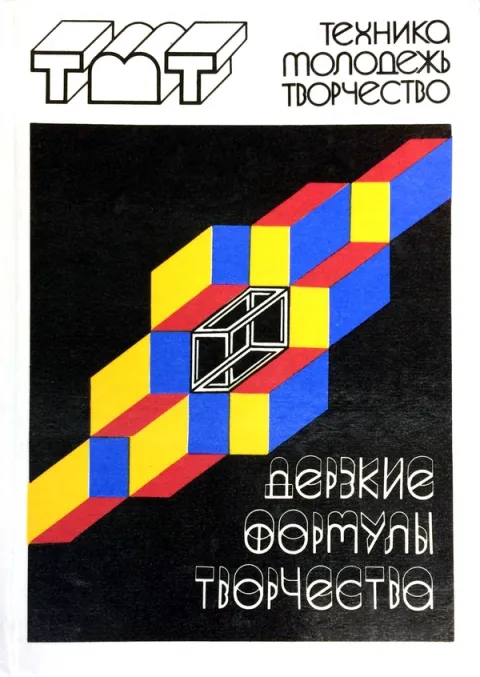
1987. "Bold Formulas of Creativity". Series "Technology-Youth-Creation"
III
TRIZ

1987. "Bold Formulas of Creativity". Series "Technology-Youth-Creation"

1987. "Bold Formulas of Creativity". This is the first book in the "Technology-Youth-Creation" series, devoted to TRIZ. The collection includes chapters written by various authors: the section written by G.S. Altshuller is devoted to a discussion of the modern provisions and ideas of TRIZ. The next section examines physical effects useful for inventors. The third part of the book is a cycle of science fiction stories by V.N. Zhuravleva, devoted to the nature of creativity.

1988
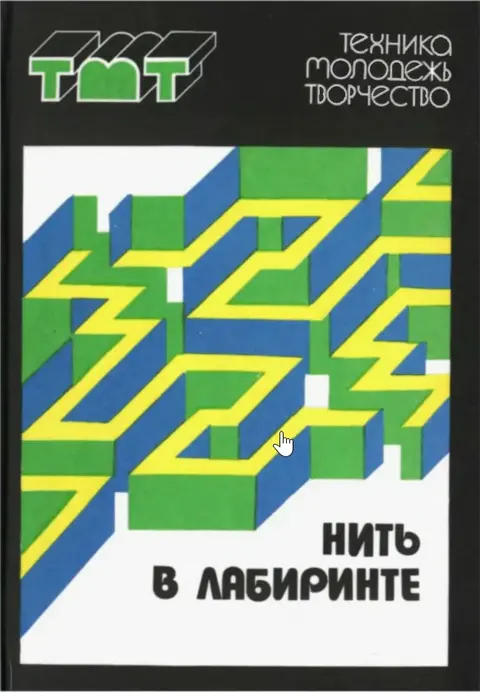
1988. "A Thread in the Labyrinth". Series "Technology-Youth-Creation"
III
TRIZ

1988. "A Thread in the Labyrinth". Series "Technology-Youth-Creation"

"A Thread in the Labyrinth". In the first part of the second collection of the series, issues of forming a set of qualities of a creative personality in a person are considered — I.M. Vertkin, "To Strive and Seek". The second part is devoted to the use of chemical effects in invention — Yu.P. Salamatov, "Feats at the Molecular Level". The third part — G.S. Altshuller, "Small Boundless Worlds" — sets forth the system of 76 standards for solving inventive problems with examples of their practical application. The final part of the collection is an excerpt from the science fiction novella "The Third Millennium" by G. Altov, devoted to possible paths for the development of creative education.

The Car and the Trees, 1988
VI
once

The Car and the Trees, 1988

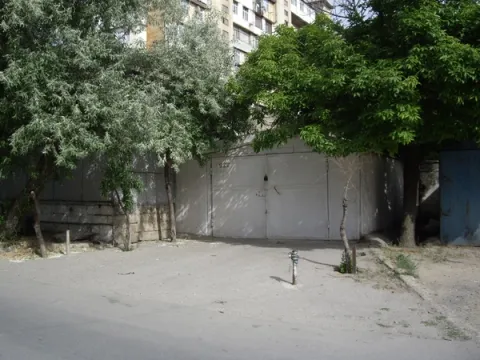
One day, a hot Baku summer in 1988 saw me walking to Altshuller's home as usual to discuss the next batch of research materials. That's when, before I had even reached the entrance to his building, I saw an extraordinary scene. Igor Vertkin and Viktor Fey were carrying buckets of water and watering the trees by Altshuller's garage. At that time in Baku, the water supply was irregular; one had to seize the moment while it lasted. I had to join in on the action. Neighbours looked on in surprise as young men, on Altshuller's instruction, carried buckets of water to water four small saplings planted at the corners of the garage. Altshuller had a theory: since he used a car, he must compensate for the harm by planting trees. Twenty years later, after a long absence, I returned to Baku. To my surprise, Altshuller's trees had grown and matured, a reminder of that old story. (As recounted by M.S. Rubin)

1989
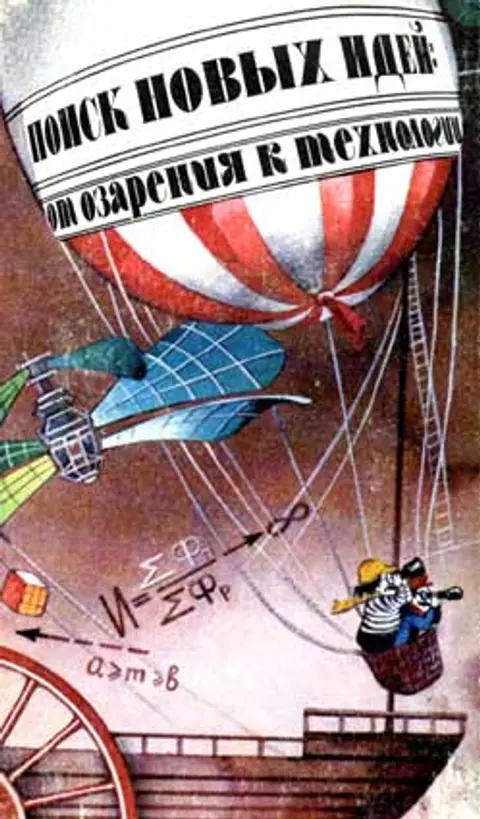
1989. G.S. Altshuller, B.L. Zlotin, A.V. Zusman. "Search for New Ideas: From Insight to Technology"
II
TRIZ

1989. G.S. Altshuller, B.L. Zlotin, A.V. Zusman. "Search for New Ideas: From Insight to Technology"

1989. G.S. Altshuller, B.L. Zlotin, A.V. Zusman. "Search for New Ideas: From Insight to Technology" (Theory and Practice of Inventive Problem Solving), Kishinev, "Cartya Moldoveneaske", 1989In this book, readers can find the texts of 40 techniques for resolving technical contradictions, 76 standards for solving inventive problems, ARIZ-85V, and tables for the application of certain physical and chemical phenomena and effects in solving inventive problems. The book also includes chapters devoted to the Laws of Technical Systems Evolution, the history of TRIZ, the solution of research problems, and the use of TRIZ-FSA. The materials presented in the book are richly illustrated with descriptions of solutions to practical inventive problems.

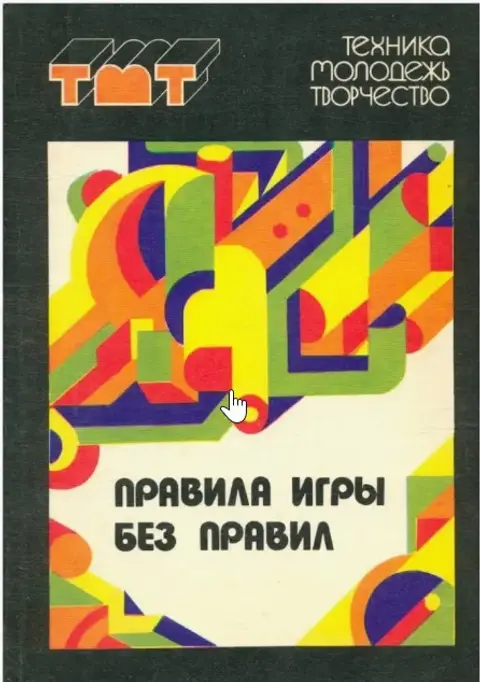
1989. "Rules of the Game Without Rules". Series "Technology-Youth-Creation"
II
TRIZ

1989. "Rules of the Game Without Rules". Series "Technology-Youth-Creation"

"Rules of the Game Without Rules". The chapter "ARIZ Means Victory" by G.S. Altshuller, from the third collection in the series, includes the full text of the Algorithm for Solving Inventive Problems ARIZ-85V with applications and examples. The collection also includes chapters on the implementation of TRIZ in production (G.I. Ivanov), a guide to geometric effects (I.L. Vikentyev, V.I. Efremov), and a chapter devoted to the analysis of educational tasks prepared by B.L. Zlotin and A.V. Zusman. The collection concludes with a selection of science fiction stories by V.N. Zhuravleva titled "Golden Roots of Audacity".

1989. G.S. Altshuller, B.L. Zlotin, A.V. Zusman. "Search for New Ideas: From Insight to Technology"
IV
TRIZ

1989. G.S. Altshuller, B.L. Zlotin, A.V. Zusman. "Search for New Ideas: From Insight to Technology"

1989. G.S. Altshuller, B.L. Zlotin, A.V. Zusman. "Search for New Ideas: From Insight to Technology" (Theory and Practice of Inventive Problem Solving), Kishinev, "Cartya Moldoveneaske", 1989In this book, readers can find the texts of 40 techniques for resolving technical contradictions, 76 standards for solving inventive problems, ARIZ-85V, and tables for the application of certain physical and chemical phenomena and effects in solving inventive problems. The book also includes chapters devoted to the Laws of Technical Systems Evolution, the history of TRIZ, the solution of research problems, and the use of TRIZ-FSA. The materials presented in the book are richly illustrated with descriptions of solutions to practical inventive problems.

On Loving One's Audience, 1989
VII
once

On Loving One's Audience, 1989

One day in 1989, Igor Vertkin and I were to travel to Astrakhan to run a seminar. As I was primarily engaged in research work and had little teaching experience, Altshuller separately "coached" me on the key topics I was to cover, particularly on the development trends of effects pointers. We discussed many subtleties of conducting seminars and interacting with audiences. That's when I asked Altshuller what was most important in teaching TRIZ. His answer was very brief, but I remembered it for decades to come: one must love one's audience. This became the key to all my subsequent seminars. And the best example of implementing this principle were Altshuller's own seminars. (As recounted by M.S. Rubin)

Typewritten telegram, 1989
VIII
once

Typewritten telegram, 1989

One day in the late 1980s, after we finished discussing current affairs as usual, Altshuller and I went for a walk in the evening, when the sweltering heat of Baku had faded. During the walk, Altshuller stopped by the post office to send an important telegram. By then, he was already quite ill and could barely write by hand; he could only type with one finger on a typewriter. That was why the text of the telegram was also typed out on paper.Just then, the woman on the other side of the counter suddenly refused to send the telegram. To be precise, she demanded an official seal on the typed text. Her logic was rigid beyond reason: if the text was typed, it meant it was prepared on behalf of some organization, and thus a seal was required.Altshuller tried every way to convince the postal worker that it was his personal telegram, typed on his own private typewriter, but he just couldn't get through to her. Altshuller was clearly irritated by the telegraph operator's absurd stubbornness. In a fit of anger, he vowed to simply throw the paper away since the telegram couldn't be sent.Knowing how principled and hot-tempered Altshuller was, one could easily assume he would do exactly that. I was annoyed by the whole scene and worried sick about Altshuller, knowing how hard it had been for him to type that text out.So when we walked out of the post office, I asked him cautiously, "Could you not throw this text away? I could send the telegram myself instead."Altshuller replied that he had no intention of throwing the text away at all—he would just send it by letter instead.

1990
X
once

The Autumn Leaf, 1990

One day in the autumn of 1990 in Petrozavodsk, I visited Altshuller. Over many years, since 1974, I had grown accustomed to agreeing on new research topics with him. This time, the topic was of great importance: forecasting the development of TRIZ and the TRIZ movement. Following our established tradition, I needed to come to him with a typed text to have something to discuss. However, Genrikh Saulovich's progressive illness introduced its own adjustments: Altshuller could no longer discuss lengthy texts, so I prepared a one-page summary to make discussion easier. That's when, on that autumn evening, I realised the usual, expected discussion would not take place. He could only speak in short phrases. I did not hear his familiar critique of my proposals. I understood that from that day forward, I would have to rely only on the ideas and guidance he had given in in the past. (As recounted by M.S. Rubin)

1991
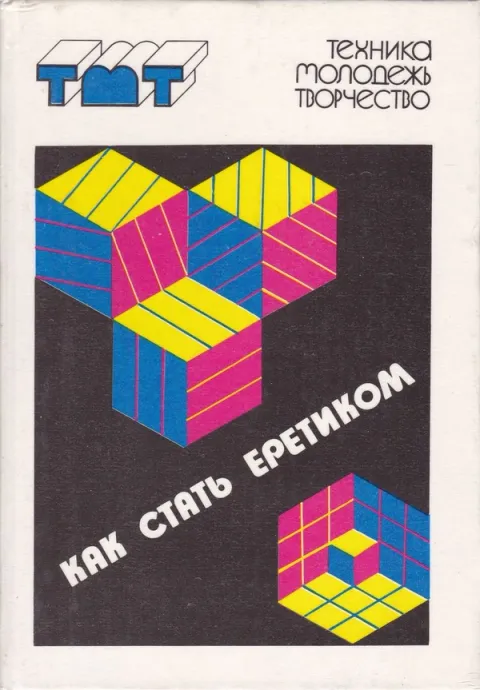
1991. "How to Become a Heretic". Series "Technology-Youth-Creation"
I
TRIZ

1991. "How to Become a Heretic". Series "Technology-Youth-Creation"

"How to Become a Heretic". The central part of the fourth Petrozavodsk collection was the section "How to Become a Heretic: Life Strategy of a Creative Personality" by G.S. Altshuller and I.M. Vertkin. The chapter "Come to the Firing Range" by B.L. Zlotn and A.V. Zusman continues the cycle of analyses of educational tasks begun in the previous collection. The collection concludes with science fiction stories by G. Altov.

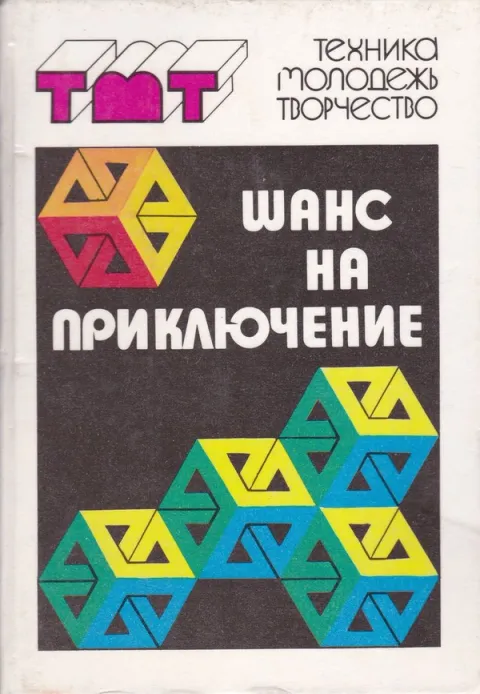
1991. "A Chance for Adventure". Series "Technology-Youth-Creation"
XII
TRIZ

1991. "A Chance for Adventure". Series "Technology-Youth-Creation"

"A Chance for Adventure". The central part of this collection was the chapter devoted to the System of Laws of Technical Development by Yu.P. Salamatov. The chapter "In Search of the Ideal Substance" by V. Fay presents a study on the theme of the "ideal substance" using water as an example. The work "What Will Come After the Final Victory, or Eight Thoughts on Nature and Technology" by G. Altshuller and M. Rubin presents a brief predictive hypothesis for the development of future tasks related to the progress of humanity. The chapter "Colors for Fantasy" by G. Altshuller is devoted to the development of creative imagination.

1993
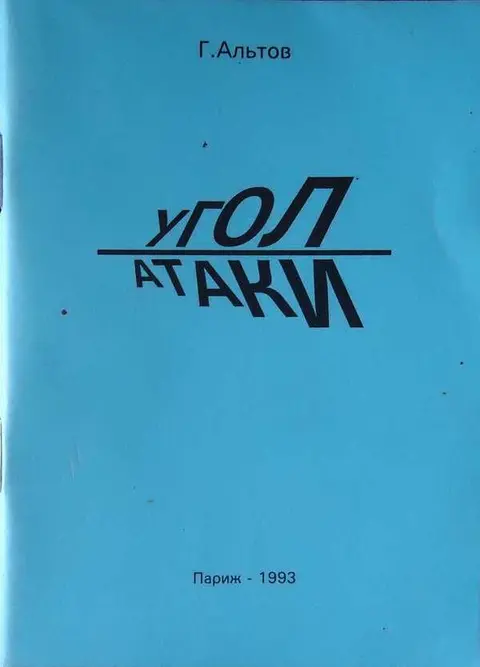
1993. G. Altov. "Point of Attack"
XII
TRIZ

1993. G. Altov. "Point of Attack"

1993. G. Altov. "Point of Attack". Paris, 1993

This work is a revised and expanded version of the author’s earlier short story "The Second Flight of the Swift Tortoise". Through the example of the protagonist, a schoolboy, the author shows how something new and useful can be created from a childhood dream and everyday materials.

1994
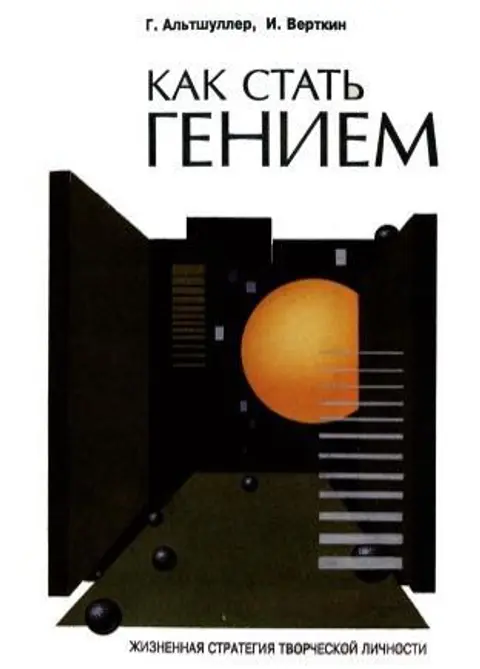
1994. G.S. Altshuller, I.M. Vertkin. "How to Become a Genius"
IX
TRIZ

1994. G.S. Altshuller, I.M. Vertkin. "How to Become a Genius"

1994. G.S. Altshuller, I.M. Vertkin. "How to Become a Genius: Life Strategy of a Creative Personality". Minsk: Belarus Publishing House, 1994

This is the most comprehensive collection of the authors' original works that formed the foundation of the Theory of Creative Personality Development (TCPD). The book consists of three major parts:

- CHOICE OF DESTINY

- GAME

- WORK

The first part, written as a series of articles and stories, is dedicated to the qualities of a creative personality, a Worthy Goal, and the art of planning. The text uses numerous examples from the biographies of real people.

The second part, which is the core of TCPD, is presented in the form of a chess match between a creative personality and external circumstances. It compiles typical moves by external circumstances against creative personalities and counter-moves by creative personalities who have gone down in human history. To develop this section, titled "Life Strategy of a Creative Personality" (LSCP), approximately one thousand biographies were analyzed, patterns in their lives were identified, and these are presented in the form of a game between a Creative Personality and External Circumstances. It is also a unique collection of problems that creative people inevitably encounter in the course of their activities.

The third part presents typical questions about creative personalities, a list of problems, a consolidated card index, and a description of an ideal creative strategy.

This book turned out to be the last one prepared and published during Genrich Saulovich Altshuller's lifetime. Essentially, it proposes a direction for the development of TRIZ by moving to a supersystem level, and sets the direction for the development of a new S-shaped curve of TRIZ evolution.

1996
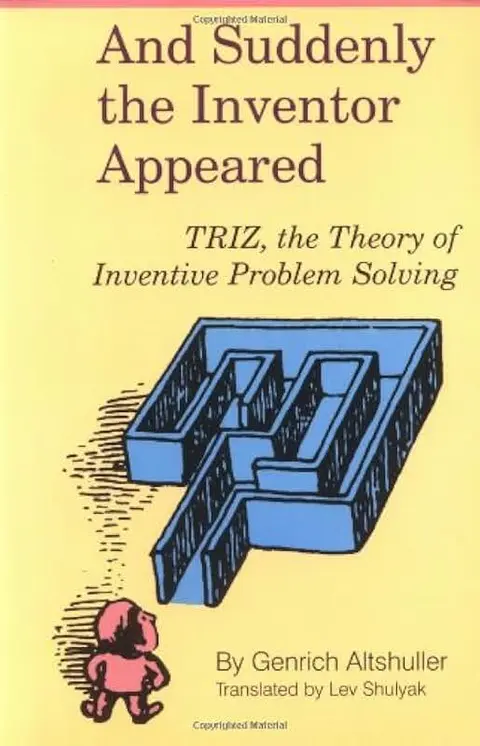
1996. G. Altov. And Suddenly the Inventor Appeared. Copyrighted Material. Translated by Lev Shulyak. USA, 1996.
IV
TRIZ

1996. G. Altov. And Suddenly the Inventor Appeared. Copyrighted Material. Translated by Lev Shulyak. USA, 1996.

1996. G.Altov. "And suddenly the inventor appeared". Copyrithed Material. Translated by Lev Shulyak. USA, 1996

A popular translation of G. Altov's book for children.

1997
Film "The Game". VGTRK "Karelia", 1997.
XI
filmography

Film "The Game". VGTRK "Karelia", 1997.

In 1997, the Karelia branch of the All-Russia State Television and Radio Broadcasting Company produced the documentary "The Game", authored by journalist Andrey Rayev. The film was dedicated to recounting the life of Genrikh Saulovich Altshuller, the founder of TRIZ theory. In its second part, students and colleagues of the TRIZ founder shared their personal experiences of encountering TRIZ and Altshuller himself, as well as their individual journeys in exploring TRIZ.

1999
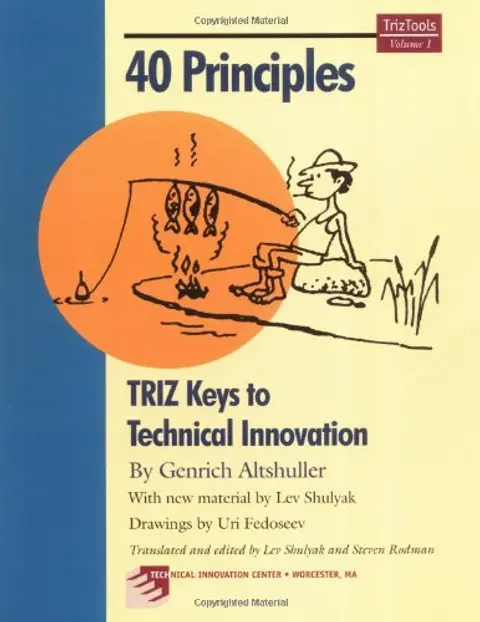
1999 год. "40 Principles. TRIZ Keys to technical innovation by Genrich Aitshuller".
III
TRIZ

1999 год. "40 Principles. TRIZ Keys to technical innovation by Genrich Aitshuller".

1999 год. "40 Principles. TRIZ Keys to technical innovation by Genrich Aitshuller". 

With new material by Lev Shulyak. Drawigs by Uri Fedoseev. Translated and edited by Lev Shulayk and Steven Rodman

2002
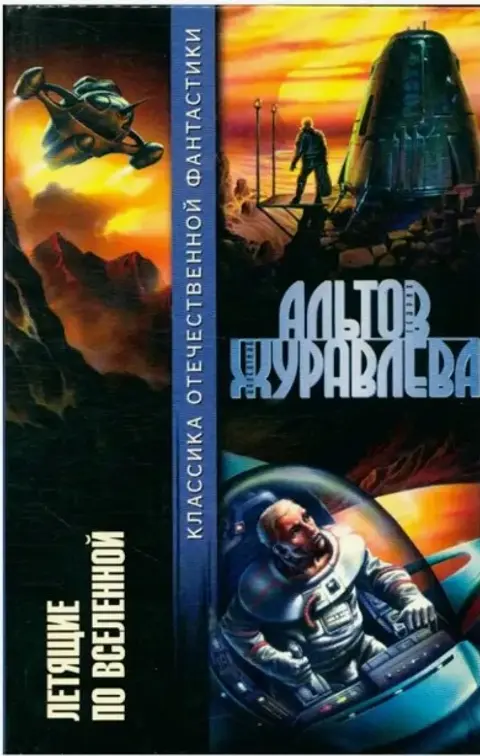
2002. G. Altov, V. Zhuravleva. "Flying Through the Universe".
X
TRIZ

2002. G. Altov, V. Zhuravleva. "Flying Through the Universe".

2002. G. Altov, V. Zhuravleva. "Flying Through the Universe". 2002. G. Altov, V. Zhuravleva. "Flying Through the Universe". Moscow, AST, 2002

"Science fiction is a form of fiction. Its purpose is not prediction, but the study of human nature (or I would say, a worldview of the world). Yet in striving for artistic authenticity and following artistic logic, the writer often foresees the future." G. Altov once said this, and these words are perhaps first and foremost applicable to the works of himself and his wife V. Zhuravleva—works that have truly become the quintessence of Russian science fiction. This science fiction is intellectual, engaging and rich in ideas, and it was ahead of its time.

2025–2026

The International Year of Genrich Saulovich Altshuller. 100th anniversary of his birth

4.II 2026

253 days left

Альтшуллер
3

Birthday of TRIZ Master Mikhail Sharapov

Mikhail Ivanovich Sharapov, TRIZ Master Diploma No. 64

10

Birthday of TRIZ Master Sergey Kravtsov

Sergey Petrovich Kravtsov, TRIZ Master Diploma No. 25

13

Birthday of TRIZ Master Mark Meerovich

Mark Iosifovich Meerovich, TRIZ Master Diploma No. 33

15
2025 TRIZ Tournament for School Students and University Students

2025 TRIZ Tournament for School Students and University Students

The 2025 TRIZ Tournament was held on October 25, serving as a platform for participants to demonstrate their knowledge and skills in the field of TRIZ. All competitors worked in teams, pooling their efforts to complete complex time-limited tasks. They showed a deep understanding of TRIZ methodology and applied its core principles to solve practical problems. Teams competed against each other in speed and accuracy, exhibiting strong creativity and excellent analytical abilities.

This tournament was more than just an intellectual competition; it was also an enlightening academic event. Participants got the chance to exchange practical experience, explore new ideas and methods, and communicate face-to-face with experts in the TRIZ field. Many noted that it was an engaging and rewarding experience that broadened their horizons and enhanced their teamwork skills.

At the end of the competition, results were tallied and prizes were presented to the winners. The top-performing teams received awards that will motivate them to further develop and deepen their expertise in TRIZ. The tournament organizers are already planning the next event, which will be even larger in scale and more engaging.

15
TRIZ Day at St. Petersburg School No. 207

TRIZ Day at St. Petersburg School No. 207

October 15 is International TRIZ Day, a professional holiday for specialists in the Theory of Inventive Problem Solving. The date was chosen for a reason: Genrikh Saulovich Altshuller, the founder of this theory and a science fiction writer, was born on October 15, 1926. Today marks the launch of the International Year of G.S. Altshuller, in honor of his centenary.A TRIZ lesson was held for Class 2-A, where the students tackled creative tasks, puzzles and problem-solving challenges. They also learned about the unique features of the inventor's profession. The session was engaging and thoroughly enjoyable!
read more

19

Birthday of TRIZ Master Igor Vikentiev

Igor Leonardovich Vikentiev, TRIZ Master Diploma No. 5

X.
7

Birthday of TRIZ Master Nikolay Kaloshin

Nikolay Grigorievich Kaloshin, TRIZ Master Diploma No. 21

12
Birthday of TRIZ Master Mikhail Rubin

Birthday of TRIZ Master Mikhail Rubin

Mikhail Semyonovich Rubin, TRIZ Master Diploma No.44, Director of TRIZ Development Department at UC RUSAL, Co-author of G.S. Altshuller, Author of the Theory of Evolutionary Systems Science

18

Birthday of TRIZ Master Yury Stupniker

Yury Iosifovich Stupniker, TRIZ Master Diploma No. 52

19

Birthday of TRIZ Master Nina Linkova

Nina Petrovna Linkova, TRIZ Master Diploma No. 27

24

Birthday of TRIZ Master Lev Shulyak

Lev Abramovich Shulyak, TRIZ Master Diploma No. 63

26
Birthday of TRIZ Master Lev Pevzner

Birthday of TRIZ Master Lev Pevzner

Lev Khatiyevich Pevzner, TRIZ Master Diploma No.42

26
Birthday of TRIZ Master Alex Lyubomirsky

Birthday of TRIZ Master Alex Lyubomirsky

Lyubomirsky Alexander Lvovich

XI.
2

Birthday of TRIZ Master Vadim Kaner

Vadim Froimovich Kaner, TRIZ Master Diploma No. 23

9

Birthday of TRIZ Master Nikolay Khomenko

Nikolay Nikolaevich Khomenko, TRIZ Master Diploma No. 59

15

Birthday of TRIZ Master Larisa Shragina

Larisa Isaakovna Shragina, TRIZ Master Diploma No. 65

17

Birthday of TRIZ Master Igor Kholkin

Igor Nikolaevich Kholkin, TRIZ Master Diploma No. 60

21
Birthday of TRIZ Master Marat Gafitulin

Birthday of TRIZ Master Marat Gafitulin

Marat Semyonovich Gafitulin, TRIZ Master Diploma No.14

31
Birthday of TRIZ Master Boris Zlotin

Birthday of TRIZ Master Boris Zlotin

Boris Lvovich Zlotin, TRIZ Master Diploma No.15

XII.
1

Birthday of TRIZ Master Alexander Narbut

Alexander Fyodorovich Narbut, TRIZ Master Diploma No. 38

8
Birthday of TRIZ Master Viktor Timokhov

Birthday of TRIZ Master Viktor Timokhov

Viktor Ivanovich Timokhov, TRIZ Master Diploma No. 54.

21
Birthday of TRIZ Master Yuri Fedosov

Birthday of TRIZ Master Yuri Fedosov

Yuri Igorevich Fedosov, TRIZ Master Diploma No. 57.

27
Birthday of TRIZ Master Mikhail Shusterman

Birthday of TRIZ Master Mikhail Shusterman

Mikhail Naumovich Shusterman, TRIZ Master Diploma No. 62.

28

Birthday of TRIZ Master Valery Mikhailov

Valery Alekseevich Mikhailov, TRIZ Master Diploma No. 34

28

Webinar "Compinno-TRIZ with LLM for Efficient Inventive Problem Solving". Speaker TRIZ Master Kulakov A.

Research indicates that between 30 to 60 percent of employees' time is spent clarifying problems or tasks. Unfortunately, spending a considerable amount of time only to discover that there is no problem or that it lies elsewhere is not just a bedtime story but an established practice leading to operational, investment, and reputational losses. However, this is only half the battle. Even a clearly defined task needs to be solved effectively.Recent studies have shown that neural networks are gradually becoming an integral part of people's lives, from suggestions about optimal physical exercise to serious data processing.However, there are stumbling blocks along the way when solving complex tasks. For example, unprepared interaction with large language models can lead to quickly obtaining mediocre results. One can waste time and resources verifying inherently weak solutions, or one can immediately move towards strong solutions.During the webinar, participants will learn how to use Compinno-TRIZ with AI to reduce the time spent clarifying problems or tasks by several times and systematically arrive at strong solutions without wasting resources on weak ones.

I.
1
Birthday of TRIZ Master Alla Zusman

Birthday of TRIZ Master Alla Zusman

Alla Veniaminovna Zusman, TRIZ Master Diploma No.16

2

Birthday of TRIZ Master Aleksey Podkatilin

Aleksey Vasilievich Podkatilin, TRIZ Master Diploma No. 40

9

Birthday of TRIZ Master Alexander Nikashin

Alexander Ivanovich Nikashin, TRIZ Master Diploma No. 37

18

Roundtable. Krasnoyarsk (Lopatin, Kraev, Trantin, Kulakov)

19

Meeting at a university in Krasnoyarsk (Trantin, Kulakov)

20
Birthday of TRIZ Master Pesach Amnuel

Birthday of TRIZ Master Pesach Amnuel

Pavel Rafailovich Amnuel, TRIZ Master Diploma No.1, Astrophysicist, Science Fiction Writer, Co-author of G.S. Altshuller

21

Birthday of TRIZ Master Volyuslav Mitrofanov

Volyuslav Vladimirovich Mitrofanov, TRIZ Master Diploma No. 35

24
Birthday of TRIZ Master Semyon Litvin

Birthday of TRIZ Master Semyon Litvin

Semyon Solomonovich Litvin, TRIZ Master Diploma No.28

26

Webinar: TRIZ Teaching Programs (Rubina)

II.
3
Birthday of TRIZ Master Vladimir Gerasimov

Birthday of TRIZ Master Vladimir Gerasimov

Vladimir Mikhailovich Gerasimov, TRIZ Master Diploma No.8

4

Birthday of TRIZ Master Miloslava Zinovkina

Miloslava Mikhailovna Zinovkina, TRIZ Master Diploma No. 18

20

Program of the Joint Webinar within the TRIZ Developers Summit (TDS) and the International TRIZ Official Association (MATRIZ Official)

Program of the Joint Webinar of the

Summit of TRIZ Developers and

MATRIZ Official in the International

Year of G.S. Altshuller

(simultaneous translation in Russian

and English)

Presentation Regulations: 45 minutes

for the presentation and 15 minutes for

questions and answers.

March 20st, 2026

04:00 – 04:15 p.m. –

Introduction to the Webinar. Rubin M., Litvin S.

04:15 – 05:15 p.m. –

Dynamics of needs and their use in the development of new products. Fey V.

05:15 – 06:15 p.m. –

Bi-poly techniques and table of their application. Trantin A. (Rubin M., SysoevS.)
06:15 – 06:30 p.m. – BREAK

06:30 – 07:30 p.m. –

Application of analogies in TRIZ. LitvinS.

07:30 – 08:30 p.m. –

Standards for solving inventive problems and their development. Kulakov A. (Rubin M.)

Participation is free. The link to the Webinar’s Zoom will be

posted on the information resources of the organisers of the Webinar:

https://100-gsa.ru https://matriz-official.net/ https://triz-summit.ru/ https://t.me/GSA_100

21

Program of the Joint Webinar within the TRIZ Developers Summit (TDS) and the International TRIZ Official Association (MATRIZ Official)

Program of the Joint Webinar of the

Summit of TRIZ Developers and

MATRIZ Official in the International

Year of G.S. Altshuller

(simultaneous translation in Russian

and English)

Presentation Regulations: 45 minutes

for the presentation and 15 minutes for

questions and answers.

March 21st,2026

04:00 – 05:00 p.m. – Resolving of Physical Contradictions by directions. Lyubomirskiy A.

05:00 – 06:00 p.m. - Logical

description and practical application of the development lines of technical systems. Li O., Rubin M.

06:00 – 06:15 p.m. – BREAK

06:15 – 07:15 p.m. – Altshuller – 100 Years: successes, challenges and the path to the human/machine

creativity. TRIZ and evolution of human thinking. Zusman A., Zlotin B.

07:15 – 08:15 p.m. - Experience in applying the CID methods in the Compinno-TRIZ software package. Rubina N. (Sysoev S.)

08:15 – 08:30 p.m. – Summing up. Litvin S., Rubin M.

Participation is free. The link to the Webinar’s Zoom will be

posted on the information resources of the organisers of the Webinar:

https://100-gsa.ru https://matriz-official.net/ https://triz-summit.ru/ https://t.me/GSA_100

23

Birthday of TRIZ Master Sergey Gubanov

Sergey Nikolaevich Gubanov, TRIZ Master Diploma No. 12

25

Roundtable. Irkutsk. (Labunsky, Trantin, Kulakov)

26

Meeting at a university in Irkutsk (Trantin, Kulakov)

29

Birthday of TRIZ Master Vadim Salnikov

Vadim Nikolaevich Salnikov, TRIZ Master Diploma No. 50

30

"TRIZ Technologies in the Educational Process" — 6th Interregional Scientific-Practical Conference with International Participation, Dedicated to the 100th Anniversary of the Birth of G.S. Altshuller

Conference Organizer

Municipal Educational Institution "Secondary School No. 55" — an innovation platform of the Federal State Budgetary Institution"Russian Academy of Education" for the theme "Constructing a Regional Model of a MultidisciplinarySchool Through the Establishment of an Interdisciplinary Basic Department of a University and Network Partnerships withOrganizations and Enterprises of Various Types"

Conference Aims and Objectives1. To facilitate the exchange of views and information, as well as the presentation and synthesis of pedagogical experience2. among conference participants on the popularization and application of TRIZ technologies in the education of modern schoolchildren,3. and the solution of educational tasks using TRIZ tools;4. To summarize pedagogical experience in applying TRIZ as an effective tool for developing meta-subject competencies5. among schoolchildren in the field of scientific and technical creativity, as well as in school engineering and technological education;6. to promote and popularize TRIZ and its derivative technologies;7. To develop conference recommendations.

Conference Tracks1. Pedagogical Practice: Didactic Tools of TRIZ Pedagogy;2. Science Fiction as a Vision of a Possible Future;3. TRIZ Technology in Working with Schoolchildren During Literature Lessons;4. TRIZ as a Trainer for Developing Soft Skills in Basic General Education Programs;5. TRIZ Tools in School Engineering and Technological Education;6. TRIZ Technologies for the Effective Formation of Competencies Among Primary School Students.

The conference theme may be refined based on proposals from prospective participants.The conference aims to establish a sustainable dialogue between educational science and the practice of teaching modern schoolchildren.The scientific program includes a plenary session, roundtable discussions, and parallel section sessions.

The core focus of the conference discussions is the pedagogical conditions for integrating TRIZ technologies into the educational process of general education institutions,within the framework of implementing the Strategy for the Development of Education in the Russian Federation until 2036 (with a prospect until 2040).

Target Participants1. Teachers of general education institutions;2. Lecturers and researchers from institutions of higher and additional professional education;3. Administrators of educational institutions;4. Specialists from municipal education management bodies and methodological services;5. Undergraduate, master’s, and doctoral students in pedagogical fields;6. Schoolchildren;7. Other interested individuals.

III.
6
Birthday of TRIZ Master Alexander Syolyutsky

Birthday of TRIZ Master Alexander Syolyutsky

Alexander Borisovich Syolyutsky, TRIZ Master Diploma No. 48.

7
Birthday of TRIZ Master Valery Tsurikov

Birthday of TRIZ Master Valery Tsurikov

Valery Mikhailovich Tsurikov, TRIZ Master Diploma No. 61.

9

Birthday of TRIZ Master Igor Gorchakov

Igor Petrovich Gorchakov, TRIZ Master Diploma No. 10

13

Birthday of TRIZ Master Valentina Kryachko

Valentina Borisovna Kryachko, TRIZ Master Diploma No. 22

15

Meeting at a university in Bratsk (Trantin, Kulakov, Volokhov)

16

Birthday of TRIZ Master Alexander Torgashev

Alexander Sergeevich Torgashev, TRIZ Master Diploma No. 55

16

Birthday of TRIZ Master Anatoly Gin

Anatoly Alexandrovich Gin, TRIZ Master Diploma No. 13

22

Webinar TRIZ in fundamental physics (Misyuchenko)

27

Birthday of TRIZ Master Viktor Ladoshkin

Viktor Seliverstovich Ladoshkin, TRIZ Master Diploma No. 30

29

Birthday of TRIZ Master Alexander Trigub

Alexander Vasilievich Trigub, TRIZ Master Diploma No. 53

IV.
10

Birthday of TRIZ Master Georgy Pigorov

Georgy Semyonovich Pígorov, TRIZ Master Diploma No. 41

25

Birthday of TRIZ Master Alexander Gasanov

Alexander Iskanderovich Gasanov, TRIZ Master Diploma No. 7

25
Birthday of TRIZ Master Valery Beliltsev

Birthday of TRIZ Master Valery Beliltsev

Valery Konstantinovich Beliltsev, TRIZ Master Diploma No.3

26
Birthday of TRIZ Master Vissarion Sibiryakov

Birthday of TRIZ Master Vissarion Sibiryakov

Vissarion Grigoryevich Sibiryakov, TRIZ Master Diploma No. 47.

27

Meeting at a university in Yekaterinburg (Trantin, Kulakov)

V.
2
Birthday of TRIZ Master Victor Fey

Birthday of TRIZ Master Victor Fey

Victor Ruvimovich Fey, TRIZ Master Diploma No. 56.

12

Birthday of TRIZ Master Margarita Bdulenko

Margarita Kapitonovna Bdulenko, TRIZ Master Diploma No. 2

13

Birthday of TRIZ Master Natalya Narbut

Natalya Nikolaevna Narbut, TRIZ Master Diploma No. 39

22

Birthday of TRIZ Master Valery Sychev

Valery Viktorovich Sychev, TRIZ Master Diploma No. 49

VI.
4

Birthday of TRIZ Master Nikolay Kolchev

Nikolay Petrovich Kolchev, TRIZ Master Diploma No. 26

7

Birthday of TRIZ Master Yuly Murashkovsky

Yuly Samoylovich Murashkovsky, TRIZ Master Diploma No. 36

15

Webinar RTV in Compinno-TRIZ (Rubina, Sysoev)

18

Birthday of TRIZ Master Yuri Gorin

Yuri Vasilievich Gorin, TRIZ Master Diploma No. 9

20
Birthday of TRIZ Master Isaac Buchman

Birthday of TRIZ Master Isaac Buchman

Isaac Beytsevich Buchman, TRIZ Master Diploma No.4

24

Birthday of TRIZ Master Anatoly Limarenko

Anatoly Vasilievich Limarenko, TRIZ Master Diploma No. 29

24
Birthday of TRIZ Master Yury Salamatov

Birthday of TRIZ Master Yury Salamatov

Yury Petrovich Salamatov, TRIZ Master Diploma No.46

25

Birthday of TRIZ Master Vladimir Petrov

Vladimir Mikhailovich Petrov, TRIZ Master Diploma No. 43

30

Birthday of TRIZ Master Alexander Kislov

Alexander Vasilievich Kislov, TRIZ Master Diploma No. 24

VII.
12

Webinar: The Meaning of MG Graphics for TRIZ (Gaftulin)

20

Birthday of TRIZ Master Esfir Zlotina

Esfir Semyonovna Zlotina, TRIZ Master Diploma No. 17

VIII.
2

Birthday of TRIZ Master Zinovy Royzen

Zinovy Yefimovich Royzen, TRIZ Master Diploma No. 45

9

Meeting at a university in St. Petersburg (Trantin, Kulakov, Rubin)

10

Meeting at a university in Moscow (Trantin, Kulakov, Rubin)

11

Birthday of TRIZ Master Kirill Sklobovsky

Kirill Afanasyevich Sklobovsky, TRIZ Master Diploma No. 51

27

Birthday of TRIZ Master Gennady Ivanov

Gennady Ivanovich Ivanov, TRIZ Master Diploma No. 19

IX.